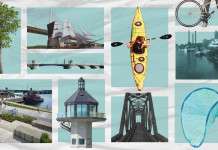
In a city full of urban development, the Burnham Wildlife Corridor is a sanctuary of prairie, savannah and woodland habitat. The BWC is the largest swath of continuous greenery on the Chicago lakefront, 100 acres where migratory birds and humans alike can rest.
Wildlife corridors refer to naturally occurring pathways that animals have learned through generations to travel along in response to changing seasons or resource availability.
Despite the name, the BWC does not strictly fit the definition of a wildlife corridor — it consists of several curated wilderness areas within the manmade Burnham Park. But it does provide a resting place, the McCormick Bird Sanctuary, for migratory birds to stop on their journey from Canada to Central and South America.

Urban development often interrupts stretches of habitat, an issue known as fragmentation. This prevents animals from making their cross-corridor journeys safely and limits their ability to roam.
Fragmentation can take a myriad of forms: Less than half a mile away from the McCormick Bird Sanctuary is the McCormick Place Lakeside Center, a building which saw thousands of bird collisions with its glass exterior until it received bird-safe window treatments in 2024.
Besides glass structures, fences and roadways are major causes of fragmentation. Barbed wire fences can entangle and potentially kill animals attempting to go through them, and vehicle-wildlife collisions are a source of injury for both animals and humans.
Mitigating the impacts of these barriers is where human constructions come in.
“Although we’re not making corridors, we can help facilitate the movement in those corridors by building wildlife crossing structures: bridges that go over the road, tunnels that go under the road to allow wildlife to move freely across these roadways. We can make wildlife-friendly fencing by lifting the bottom strand on a wire up, making it smooth, making it not as tall,” Jeremy Romero, Wildlife Connectivity Manager for the National Wildlife Federation, said.
Wildlife crossings, which are sometimes conflated with corridors, are developments created by humans to improve the accessibility of corridors. Romero said roadway crossings are more than 90% effective at reducing wildlife-vehicle collisions, potentially sparing tens of millions of dollars in property damage, as well as increasing animal and motorist safety.

The success of these crossings is dependent on their location. Along roadways, assessments called hotspot analyses use GPS collar data to map the movement of animals across a landscape and determine where the highest number of collisions occur. Wildlife exclusion fencing can then be installed to guide animals toward the crossing location, whether it be an overpass or underpass.
“Every day, we’re learning more and more about wildlife moves across the landscape and what locations are gonna be the … highest priority for a wildlife crossing project. So there’s never gonna be an instance where we’ve built all the wildlife crossing structures in our country and everything is A-OK,” Romero said. “It really takes a group effort of pragmatic mindsets that want to work toward a common goal of reducing fragmentation.”
According to Romero, research and construction for crossings can cost millions of dollars. This means the federal budget has significant influence over the ability of organizations like the Bureau of Land Management to improve habitat connectivity.
The Wildlife Crossings Pilot Program, a five-year program enacted as part of the Infrastructure Investment and Jobs Act of 2021, allowed state agencies, local governments, sovereign tribal nations and other entities to apply for grants to sponsor these projects. This program has been a big help to Midwestern states like Michigan, which Romero said received $467,000 to conduct a statewide hotspot analysis study.
A compilation of wildlife crossing success stories includes structures from many Midwest states, from a turtle underpass in Minnesota to culverts for amphibians in Ohio. In the same report, Missouri, Nebraska and South Dakota are also listed as recipients of Wildlife Crossing Pilot Program awards in 2023.
The feasibility of crossings is also dependent on the support given to the organizations that manage the land.
“Tribes and sovereign nations have to essentially do a lot of the similar work that federal agencies and state agencies do with a fraction of the resources,” Romero said. “Wildlife know no boundaries … They don’t know jurisdictions exist. And so making sure that you work together is important.”
Glenn Harper, the Range and Wildlife Division Manager of the Santa Ana Department of Natural Resources, echoes this idea. The Santa Ana Pueblo people are a federally-recognized tribe in New Mexico whose nearly 80,000 acres of land is a link in a wildlife corridor that spans the height of the United States.
“We’ve been fortunate to be able to cobble together different grants through the years to learn about the wildlife here and to do habitat restoration, but it’s very competitive,” Harper said. He is not a tribal member himself. “Tribes traditionally are way underfunded. Considering the amount of land that tribes manage, the discrepancy in the amount that goes to federal and state agencies is huge.”
Beyond ecological conservation, Harper said protecting the freedom of wildlife movement on the Pueblo is also critical to the culture of the tribe.
Nurturing cultural connections to nature is also a goal of the Burnham Wildlife Corridor. Alongside the wildlife preserves in the corridor, there are five gathering spaces designed by teams of artists and community organizations as part of the Roots & Routes Initiative.

“Historically, this has been both a perception and oftentimes a reality that social and ecological goals are difficult to integrate,” Jacob Campbell, an environmental social scientist who helped establish the Roots & Routes Initiative, said. “The gathering spaces approach is a good example of an attempt to change that … To have [community residents’] interests and sometimes their cultural traditions, their languages, and so forth, actually become a feature of that landscape.”
Partners for the project include a literary center based in Pilsen called Contratiempo, the Chinese American Museum of Chicago in Chinatown and the South Side Community Art Center in Bronzeville.
Campbell said that strengthening people’s personal and cultural relationships with nature is a vital step toward creating an attitude of stewardship and care for the environment.
“Nature does provide this venue … for people to just be their best selves,” Campbell said. “The particularly culturally relevant aspects of connections to nature and those different traditions, it just gives us something to connect with each other around.